Electric Trike vs Electric Bike: Which Should You Buy?
A trike wins at stops, starts and carrying things. A bike wins on weight, storage and speed. Here’s how to tell which matters more for you.
We earn commissions from paid links. As an Amazon Associate I earn from qualifying purchases. Our picks are based on published specs, certifications and independent reviews — brands don’t pay for placement. Details.
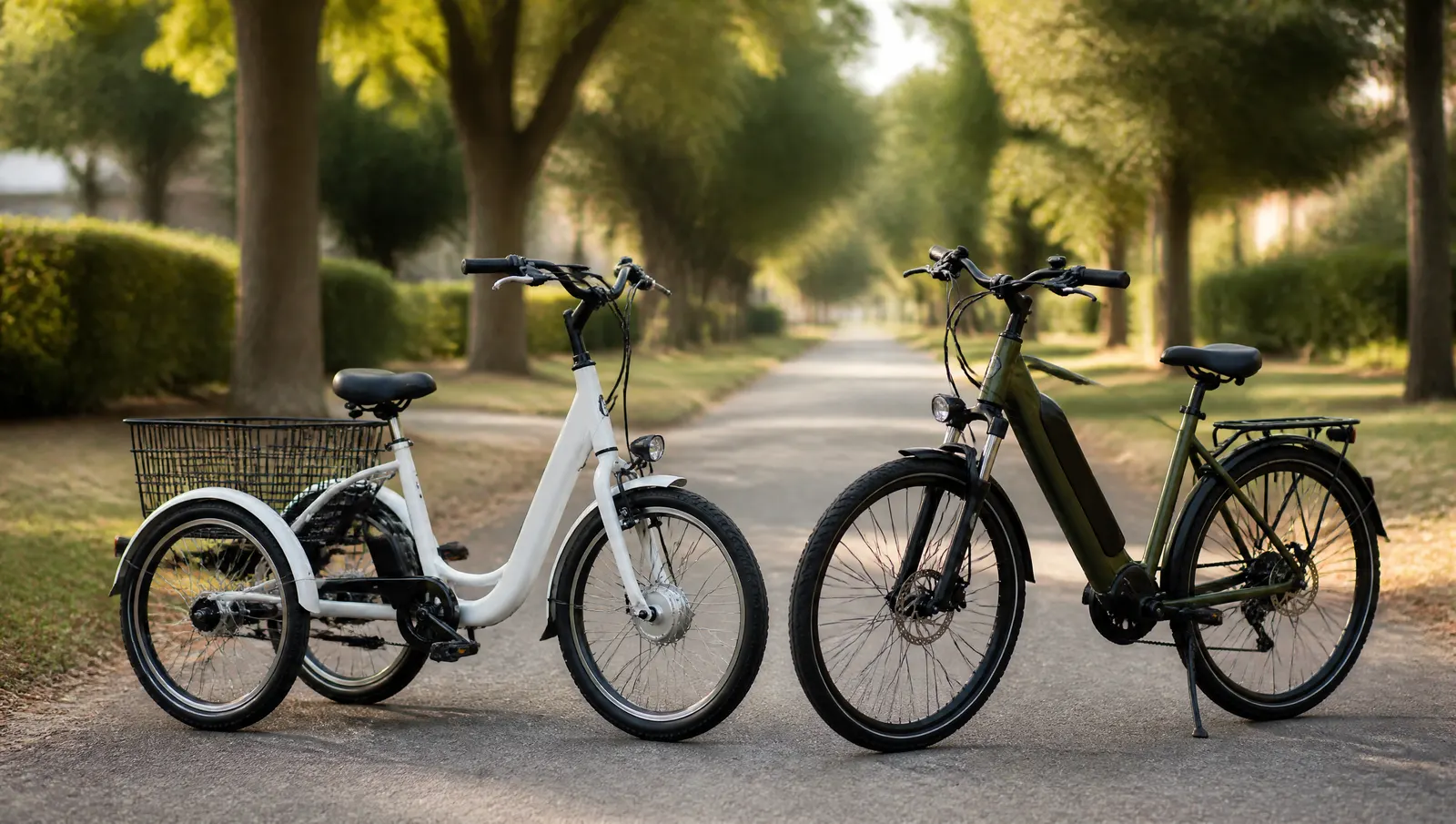
If you are shopping for an electric ride and keep going back and forth between three wheels and two, the decision usually comes down to one question: is balance at low speed the thing stopping you from riding? If it is, a trike solves it in a way no bicycle can. If it isn’t, an e-bike is lighter, smaller, faster and usually easier to live with.
Below we compare the two using published manufacturer specs and independent reviews — we did not run our own ride tests — and finish with a checklist you can answer in a couple of minutes.
The quick answer
| What matters to you | Better choice | Why |
|---|---|---|
| Stopping, starting and waiting without putting a foot down | E-trike | It stands on its own; you never balance. |
| Carrying groceries or a pet basket | E-trike (usually) | Big rear baskets and a parking brake make loading easy. |
| Fast or tight cornering | E-bike | A bike leans into turns; a trike can’t and must slow down. |
| Storage in an apartment, elevator or small car | E-bike | Narrower, lighter and much smaller folded. |
| Commuting at 20+ mph | E-bike | Most trikes are set to 14–16 mph. |
| Narrow trails and bike lanes with bollards | E-bike | A trike is about 30 in. wide. |
| Riding after a long break from cycling | Either | Pick the trike if balance is the worry, the bike if it isn’t. |
Legally, a trike is usually just an e-bike with three wheels
Federal consumer-product law defines a low-speed electric bicycle as “a two- or three-wheeled vehicle with fully operable pedals and an electric motor of less than 750 watts,” whose motor alone can’t push a 170-pound rider past 20 mph on flat ground. So in federal terms an e-trike and an e-bike sit in the same category.
Where you may ride is decided by your state. Most states use the three-class system from the PeopleForBikes model law: Class 1 (pedal assist to 20 mph), Class 2 (throttle, assistance cut at 20 mph) and Class 3 (pedal assist to 28 mph). Most adult trikes fall well inside Class 2; the Jasion JT18 tops out at 16 mph and the Lectric XP Trike 2 at 14 mph. Check your state DMV or transportation department for local rules on paths and age limits.
How they ride: the real difference
A bicycle is stable only while it moves. At a stop sign, on a slow climb or when you dismount, you balance it — and those are the moments many riders find hardest. A trike removes that entirely: you can stop mid-path, sit, and set off again.
The trade-off is cornering. A bicycle leans into a turn; a trike stays flat, so in a fast, sharp turn your weight shifts onto the outside wheel. Trike riders brake before the corner and lean their upper body inward. We cover the technique in our guide to whether electric trikes are safe for seniors. If you like to ride briskly on twisty paths, that difference will matter every day.
Worked example: weight and storage space
Size is the trike’s biggest practical cost, and it’s easy to underestimate. Here are the makers’ published figures for two folding trikes and one popular folding e-bike, with the folded box volume we calculated from them (length × width × height):
| Model | Weight with battery | Width ridden | Folded size (in.) | Folded volume |
|---|---|---|---|---|
| Jasion JT18 (trike) | 88 lb | 29.5 in. | 41.3 × 35.4 × 48.8 | ≈ 41 cu ft |
| Lectric XP Trike 2 (trike) | ≈ 86 lb (79 lb + 7 lb battery) | 30 in. | 36.5 × 38 × 26 | ≈ 21 cu ft (16.5 with front wheel off) |
| Lectric XP 4 500W (e-bike) | ≈ 72 lb (measured by ElectricBikeReport) | handlebar width only | 37 × 17 × 29 | ≈ 11 cu ft |
What this means in practice:
- Doorways: accessible doorways must give at least 32 inches of clear width under the ADA standards. A 30-inch trike fits through that, with about an inch to spare on each side — measure your own garage, gate and hallway doors, because many are narrower.
- Car transport: even folded, the trikes are two to four times the volume of the folding e-bike. The XP Trike 2 folds low (26 in.), which suits a hatchback or SUV floor; the JT18 folds shorter in length but stays tall, so check your cargo-area height.
- Lifting: at 86–88 lb, neither trike is a one-person lift for most people. Plan on a ramp, a second person or ground-level storage.
Cargo and payload
Trikes are built around carrying things. The XP Trike 2 lists a 415 lb maximum payload with a 75 lb rear basket, and the JT18 is rated for 300 lb by Jasion. Just as useful, a trike doesn’t fall over while you load it — set the parking brake and fill the basket.
E-bikes aren’t helpless here, though: the XP 4 has a 330 lb total payload and its rear rack is rated to 150 lb, according to ElectricBikeReport. The difference is less about how much weight they hold and more about how easy it is to load and ride with an awkward, top-heavy load.
Price
Trikes aren’t necessarily more expensive. At the makers’ own stores in November 2026, the Jasion JT18 was listed at $699 on sale (regular $1,299), the Lectric XP Trike 2 at $1,499, and the Lectric XP 4 e-bike from $999. Prices change often, so treat these as a snapshot.
Who should choose which
Choose an electric trike if balance at stops worries you, you stopped cycling after a fall or because of balance, you mainly ride at relaxed speeds on paths and quiet streets, you want to run errands with a big basket, and you have ground-level space to park something 30 inches wide.
Choose an electric bike if you balance comfortably, you want to commute or keep up with traffic at 20 mph or more, you live upstairs or use an elevator, you carry it in a small car, or you ride narrow trails.
If a trike is the right fit, the Jasion JT18 is our top value pick: it folds, has a rear differential, and is Class 2 at 16 mph. See how it compares with five other models in our guide to the best electric tricycles for adults.
Two-minute checklist
- Do you avoid riding a bike today mainly because of balance at stops? Yes → trike.
- Do you need to go faster than 16 mph regularly? Yes → e-bike.
- Is there a 32-inch-wide path from where you’ll store it to the street, without stairs? No → e-bike.
- Will you often carry 20+ lb of shopping? Yes → lean toward a trike.
- Will you lift it into a car alone? Yes → e-bike, or a trike with a ramp.
If you answered “trike” to the first question, that usually outweighs everything else: the best e-bike is the one you’ll actually feel confident riding.
Frequently asked questions
Is an electric trike easier to ride than an electric bike?
It is easier at low speed: a trike stays upright when you stop, start or wait, so you never have to balance. It is not easier in fast corners, because a trike can't lean into a turn; you have to slow down more before turning than you would on a bike.
Is an electric trike legally the same as an electric bike?
Under federal consumer-product law, yes: a low-speed electric bicycle is defined as a two- or three-wheeled vehicle with working pedals and a motor under 750 watts that tops out below 20 mph on motor power alone. Where and how you may ride is set by each state, and most states use a three-class e-bike system, so check your state's rules.
Are electric trikes heavier than electric bikes?
Usually. The folding trikes we compared weigh about 86 to 88 pounds with the battery, while a popular folding e-bike from the same maker as one of them weighs about 72 pounds. Trikes are also roughly 30 inches wide, which matters for doorways, elevators and car trunks.
Can an electric trike go as fast as an electric bike?
Most adult e-trikes are set slower. The trikes we compared top out at 14 to 16 mph, while many e-bikes reach 20 mph on throttle or 28 mph with pedal assist. For a trike, a lower top speed is a sensible design choice because cornering speed is its main limit.
Sources
- 15 U.S.C. § 2085, low-speed electric bicycles — Cornell Law School LII
- Model Electric Bicycle Legislation (three-class system) — PeopleForBikes, via Rails to Trails Conservancy
- Jasion JT18 eTrike product page (specs, price) — Jasion
- Lectric XP Trike2 product page (specs, price) — Lectric eBikes
- Lectric XP 4 (500W) Review — ElectricBikeReport
- 2010 ADA Standards for Accessible Design, 404.2.3 Clear Width — U.S. Department of Justice